We’re celebrating, having won the School Travel Awards – Best Large School Tour Operator award!

Grindavík: What Would You Take If You Had to Leave Home Tonight?

Last updated: Sep 28th, 2026


I have travelled to Iceland many times as a geographer and Rayburn field study tutor. It is a country where you quickly become used to talking about volcanoes, earthquakes, glaciers and lava. People. Culture. History.

They are part of the geography.

With my groups, we stand beside lava fields and explain plate tectonics. We look at maps showing the Mid-Atlantic Ridge. We talk about magma, fissures and earthquake swarms. For an A-level Geography student, Iceland can sometimes feel like an enormous outdoor textbook.

But Grindavík changed the story for me.

Because this isn’t really a story about an unpronounceable volcano! It is more than that. It is a story about people having to leave home. That raises a much more difficult question. How would you cope if it happened to you?

When the Ground Started Moving

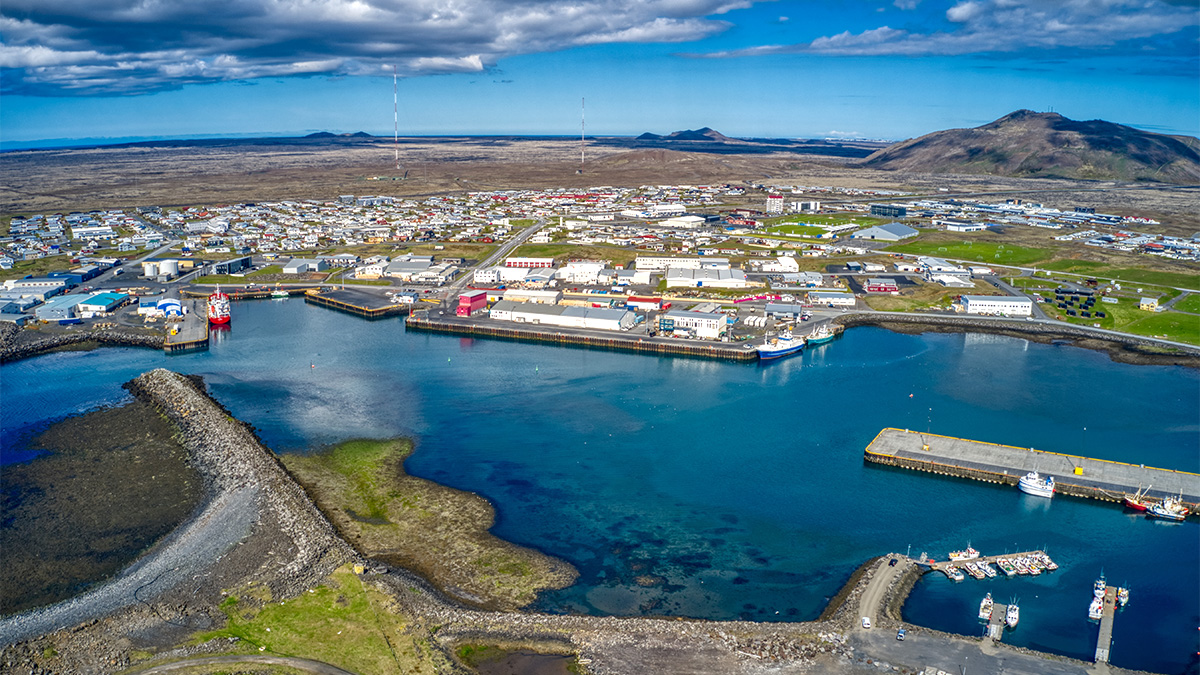
Before November 2023, Grindavík was a small fishing town of around 3,800 people on Iceland’s Reykjanes Peninsula. We often stopped, walked down to see the harbour, and had a delicious meal at Papa’s Pizzeria! People went to work. Children went to school. Football was played. Dogs needed walking. Shopping had to be done. Dinner had to be made.

The harbour was at the heart of the local economy and fishing had shaped the community for generations. This wasn’t some remote settlement sitting beneath a smoking volcanic cone. It was home. It was cosy.

Then, during the autumn of 2023, the ground began behaving strangely. Earthquakes increased dramatically. Roads moved. Cracks appeared. Scientists could see that magma was accumulating underground. For me and the Rayburn trips I led, this was exciting.

On 10 November 2023, the situation suddenly became much more serious. A huge underground intrusion of magma developed, essentially a vertical sheet of molten rock forcing its way into a crack in the Earth’s crust. Scientists later calculated that this intrusion was about 15 kilometres long and actually extended beneath Grindavík. Much of the movement happened in only about six hours. The authorities made the decision nobody in a town ever wants to hear.

Evacuate.

Nearly the entire population had to leave. Imagine hearing that announcement in your town, Glasgow, Manchester or wherever you live. You are leaving your house tonight. Actually, you have 15 minutes!

What Would You Take?

You don’t know exactly what is going to happen. And you don’t know when you will be coming back… if you will be coming back! What would you take? This is the part of the Grindavík story that interests me most.

We stop in the town and spend time looking at the outdoor exhibition showing photos taken during these days. Forget geography for a moment. Think about you and your family. Your photographs. Laptop. Clothes. Trainers. School notes. The ridiculous objects you’ve kept since you were six. The birthday card from your gran. Your pet. Your guitar. Your football shirt.

What matters? Suddenly, a house containing hundreds of possessions has to be reduced to what you can carry.

Some Grindavík residents were later allowed back into parts of the town under controlled conditions to collect important belongings. People queued in cars, hoping they would get the opportunity to retrieve possessions while rescue teams supervised them.

Opening your own front door knowing that you might have to close it again without knowing when or whether you will properly live there again.

When a Town Becomes a Ghost Town

Interestingly, Grindavík wasn’t destroyed by an eruption. The first damage came from the ground itself moving. Large cracks tore through roads and properties. Parts of the town dropped as faulting created a rift through the settlement.

Then, on 18 December 2023, an eruption began north of Grindavík. For a while, the town escaped the lava. But on 14 January 2024, another eruption began much closer. A fissure opened near the town, and lava crossed into Grindavík. Houses caught fire. Three homes were ultimately destroyed by the lava. There was the threat of poisonous gases silently creeping down to the town.

Imagine being one of those families. One Grindavík resident described watching events through webcams as lava approached his part of town. Most of the family’s possessions were still inside the house. There was almost nothing they could do except watch. That sense of helplessness is perhaps something no geography diagram can properly explain.

The evacuation didn’t simply move 3,800 people from A to B… it broke apart a community. Families found accommodation elsewhere. Children moved schools. Adults changed jobs. Friends who previously lived a few streets apart could suddenly be living in different towns.

Many eventually settled around Reykjanes or in the Reykjavík area. The Icelandic government also established arrangements allowing homeowners to sell qualifying properties through a state-supported scheme at 95% of their insured value. Money helps. But money cannot immediately replace a community. If the conditions permit, my groups drive through Grindavík. As the coach goes quiet, there is a feeling of sadness. This is what a ghost town looks like.

A 2026 survey showed how long the effects have lasted. Only around 10% of respondents had moved back to Grindavík, while many others had established lives elsewhere. Some families said children had already started putting down roots in their new communities. The survey also found significant continuing effects on residents’ wellbeing.

Grindavík in the Autumn of 2026

Yet this isn’t a story without hope. Something quite remarkable is now happening. Grindavík is slowly coming back. In August 2026, preschool education returned to the town for the first time since the evacuation. Thirteen children were registered.  Then, on 25 August 2026, Grindavík’s primary school reopened. Just 26 pupils walked back into the school. Twenty-six doesn’t sound very impressive when compared with a large British secondary school. I think it is magnificent. Because those 26 pupils represent something far larger than a school register.

They represent families saying: ‘We believe there can still be a future here’. The school building itself has undergone strengthening and improvements, while evacuation planning remains part of everyday life.

Local politicians have committed themselves to rebuilding a safe, functioning community in which residents have a genuine choice about returning. Their reconstruction plans emphasise safety, trust, resilience and community.

Living With Risk

But nobody can simply declare the geological story finished.

As of late summer 2026, earthquake activity near Grindavík and the Sundhnúkur crater row was low, but scientists were still recording slow uplift and continuing magma accumulation beneath the Svartsengi area. The Icelandic Meteorological Office says another magma intrusion — and possibly another eruption — remains a realistic scenario. Previous events have sometimes provided only 20 minutes to a few hours of warning.

That is the reality of living with risk.

Could you go back? That is the question I would ask every A-level student visiting Iceland. Suppose Grindavík was your town. You have been away for two or three years. You now have another house. You have made new friends. Perhaps your parents have different jobs. Your younger brother likes his new school. Then someone tells you it is possible to return.

Would you want your old life back badly enough to live with the possibility of another evacuation? Or would you decide that home is no longer a place — it is wherever your family happens to be?

There isn’t a correct answer. And perhaps that is why Grindavík is such an important geographical case study. Yes, it teaches us about constructive plate margins, magma intrusions, fissure eruptions, hazard management and resilience.

But travel should teach us something more than what will appear in an examination.

Grindavík asks us to think about citizenship, community, responsibility and belonging. It asks us to imagine standing in someone else’s shoes.

When I take students to Iceland, I want them to look at the landscape. I want them to understand the science. I certainly want them to take photographs.

But I want you to think about the human impact, and the next time someone tells you that 3,800 people were evacuated from Grindavík, don’t simply remember the number… remember that every one of those numbers had a front door. And behind every front door was a life.



Author

Ian Geddes

Field Study Tutor


Glaswegian Ian Geddes has been a Field Study Tutor with Rayburn Tours since 2011 and specialises in Iceland and Morrocco. In that time, he’s completed almost 80 trips!

He’s taught for decades. Lectured. Been involved in the Scottish exam system. Authored the course textbook for higher geography in Scotland. He also brings barrels of fun and learning to the classes he leads while on tour.

Mixing laughs with a vast back catalogue of educational content, Ian quickly dispels any teacher-student relationship with classes on tour so he can educate on a more informal level.